
Renée Hodges, Author
Although her Louisiana roots run deep, Renée Hodges and her husband have called North Carolina home for the past thirty years.
Hodges has worked as a campaign manager for a candidate for the Texas State House of Representatives (she won); front desk person at a ski resort; and volunteer recruiter and registration head during a presidential campaign in New York City.
She also co-wrote and self-published the Best Kept Secrets series of guides in the 1980s.
Settling into motherhood and raising a family has been her most satisfying work, however, and today she is a wife, mother of three, writer, investor, community volunteer, and avid tennis player.

Her Book:
Saving Bobby – Heroes and Heroin in One Small Community
A raw, honest, deeply moving memoir about the difficulties of managing recovery from opioids —the number one killer of American kids age 18–25 — told from the perspective of the addict’s aunt, who took him in and dedicated herself to helping her nephew save himself.
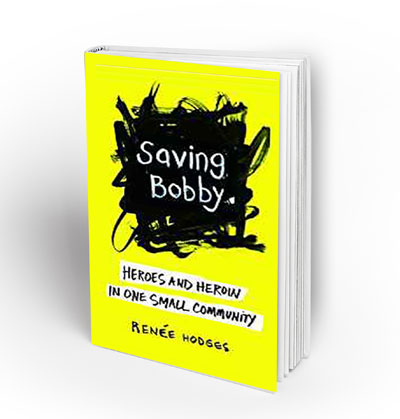
“Saving Bobby” FREE BOOK EXCERPT!!
Get a Free Chapter of the Book, Saving Bobby, Heroes, and Heroin in One Small Community!! Click on the link below to receive your Free Book Excerpt!
“I am sitting on the back porch of our condo bawling. I just finished Saving Bobby and I am filled with a belief that this 349-page book is the bravest thing I have ever seen in print. As Renee Hodges made it so clear in the end and was so apparent in each page, this is her story and maybe her eventual salvation. This process has brought Hodges to her darkest places and she found her salvation there. This sounds simple but I know how really hard that is. No one wants to do that. But she did.”
“As an orthopedic surgeon, I can say that we have faced the Perfect Storm in unwittingly facilitating opioid addiction in our patients . . . This has created an environment where the downstream catastrophe of opioid addiction has not been prioritized or even really thought much about. Renee Hodges has now given us a very loud, clear wake-up call that we must heed . . . One has to ponder the tremendous good fortune and massive effort required to shepherd Bobby through the process of recovery.”
“If you have a recovering substance abuser in your life or even if you don’t, this is an engaging read and a page turner. A truly inspiring look at a young man who was on a downward spiral until he found the right person to help him.”
“Renee Hodges spent a courageous year on the front lines of opiate addiction by taking in her struggling nephew, Bobby. Her story of his addiction odyssey is an all-too-common and silent experience in modern America. This story . . . exposes how difficult addiction can be, how it can be found anywhere—rich or poor—and ultimately how it may be overcome. Hodges’s story grips the reader from the very first page. Out of her experience with her nephew comes an immensely moving and ultimately uplifting portrait of one American family as it confronts—and surmounts—addiction and fear.”
“As a practicing pediatrician facing the challenges of a growing number of ever younger opioid abusers, and the ripple effect it has on the families and the communities they live in, I find Renee Hodges’s book couldn’t be more timely. Hodges’s straightforward approach, common sense, humor, and honesty bring a heartfelt reality to a growing problem faced by far too many. This book is a must-read for all of us.”
“…strikingly personal and lyrically told…. engrossing….A heartfelt, inspiring, and deeply moving chronology of substance abuse and enduring, unconditional familial love.”
“As a middle school/upper elementary teacher for the past twenty years, this book reminded me how easily and how many people have family members or friends who suffer from addiction. There is no shame or reason to judge; rather, we should accept who they are and offer them support. Everyone should read this book.”
“Having worked with middle schoolers for years, I’ve seen many young people from every socioeconomic group struggle with substance abuse. Addiction in their families, of their friends, and of their own, often resulting in permanent emotional and physical scaring. Teachers and parents will benefit from reading this eye-opening account into what might be an unfamiliar reality.”
“The behind-the-scenes story, which Hodges so beautifully described, was gut-wrenching, but for those searching for hope with a family member or loved one, I believe this book could be life changing.”
“Hodges bravely shares the events leading to Bobby’s addiction and places them in context—letting us see family behaviors and cultural patterns that contributed to the challenge. She confronts the stigma of shame surrounding addiction—in a real and personal way. The book is also a love story: a story of a woman who refuses to do the convenient thing and give up on her nephew. Its message provides encouragement for the many families that are involved in this same struggle.”
“Start to tell anyone the premise behind Renee Hodges’s remarkable book, and odds are they’ll stop you before you get two sentences out. Their faces betray stunned recognition—’That’s what happened to my brother’s youngest daughter’; ‘Oh dear heaven, you could be talking about my oldest son’; ‘My best friend’s son died from an overdose when he was twenty, she’s never been the same”—because this story, though it is so poignantly Bobby and Renee’s story, belongs to us all. None of us has gone untouched by this tragic, life-altering epidemic. Saving Bobby strikes a chord in all of us: drawn by the larger picture of a frightening epidemic, we are caught in the gripping drama of the personal. This is a book you cannot put down. This is a story you cannot forget—nor should you.”
Book Forward by the Author, Renée Hodges
I didn’t go into my nephew Bobby’s recovery with any professional experience but it just stood to reason that if I wanted to help my loved one, I should surround him with an atmosphere of full disclosure and transparency, a supportive place where he could not hide or be hidden. Only later did I realize how many try to conceal their family’s struggle with addiction, isolating themselves and causing undue stress and shame . . . Addiction is not a parenting failure or something to be embarrassed about. Secrecy, cover-ups, excuses, and denial do not help an addict—or a recovery. This hiding subtly reinforces that the addiction is a secret and therefore shameful. Being truthful from the get-go also avoids the awkwardness of that inevitable moment when the addiction is discovered by friends.
If the addict thinks his supporters, family, and friends are concealing his addiction out of shame, he will internalize that shame, and it will become one more roadblock on the way to recovery. Addiction plus shame is a horrible combination.
For the addict, it may be that hiding or ignoring addiction also gives the disease more power. The more secretive we are about our addiction, or that of family or friends, the easier it is for the addict to shirk accountability or for an enabler to continue the cycle of enabling.
As much as I would like to pretend there is no addiction in my family, there is. This is the simple truth. Addiction is a disease and, like breast cancer or heart disease, it can run in families. Pretending otherwise will not make it go away.
For years, I watched as my family hid from the stark reality of addiction. If we don’t say it, it ain’t true. If you can’t see it, we don’t have to face it. Excuses, avoidance, and denial. My family, like millions of other families, felt that talking about addiction openly would be airing our dirty laundry, but I never bought into it. All those years of secrecy had simply allowed succeeding generations to be blindsided by their vulnerability to addiction.
Secrets make you sick, my friend. Reach out and find your community—whether you are the caregiver, the recoverer, or the next-door neighbor.
There can be no denying: the best way to help those that are recovering is to recognize that we are all in this together.